SETUP: Iceland2_MARBL_2024
This notebook configures the high-resolution regional grid and forcing for the Iceland2_MARBL_2024 configuration.
Grid generation/import: Build or load the EMOD-based child grid and inspect vertical coordinates.
Tides: Create TPXO tidal forcing on the Iceland2 grid.
Initial conditions: Interpolate from the parent Iceland1 ROMS restart (physics + BGC).
Surface forcing: Generate ERA5-based physics and UNIFIED BGC surface climatologies for 2024.
Child (Iceland3): Define the nested fjord-scale grid and write its grid and nesting files.
Rivers: Build and customize river forcing (volume and BGC tracers) for Hvalfjörður.
Run cells in order when regenerating Iceland2 input files or updating river/BGC assumptions.
ROMS-TOOLS setup for Iceland2_MARBL_2024
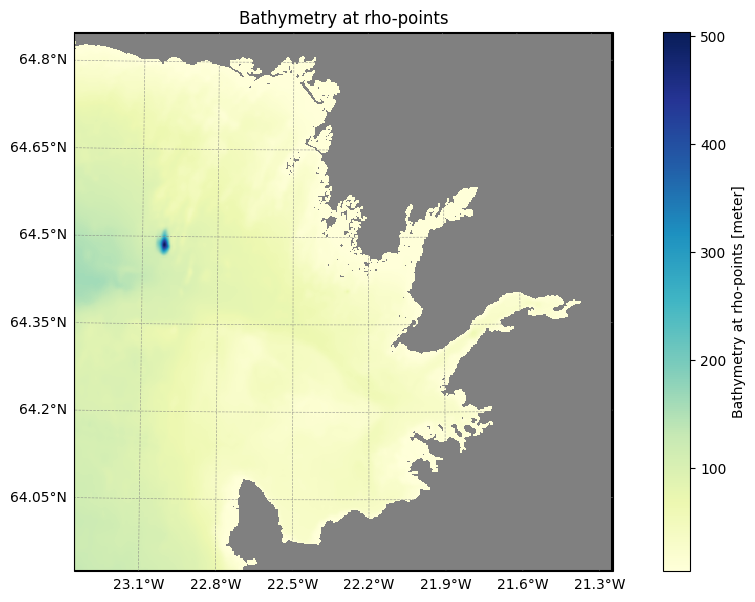
First step is to set up the outer grid using ROMS-TOOLS and save the grid file.
from roms_tools import Grid/home/x-uheede/.conda/envs/romstools-test/lib/python3.13/site-packages/tqdm/auto.py:21: TqdmWarning: IProgress not found. Please update jupyter and ipywidgets. See https://ipywidgets.readthedocs.io/en/stable/user_install.html
from .autonotebook import tqdm as notebook_tqdm
project='/anvil/projects/x-ees250129/x-uheede/INPUT_files/Iceland2_MARBL_2024/RT_EMOD/'
datasets='/anvil/projects/x-ees250129/Datasets/'
model_name='Iceland2'
child_name='Iceland3'
grid_path='/anvil/projects/x-ees250129/x-uheede/INPUT_files/Iceland2_MARBL_2024/RT_EMOD/Iceland2_grid.nc'
%%time
grid = Grid(
nx=512,
ny=512,
size_x=102.4,
size_y=102.4,
center_lon=-22.3,
center_lat=64.39,
rot=0,
mask_shapefile=datasets+"GSHHS/gshhg-shp-2.3.7/GSHHS_shp/f/GSHHS_f_L1.shp",
close_narrow_channels=True,
topography_source={
"name": "EMOD",
"path": datasets+"EMODnet_C2.nc"},
N=60 # number of vertical layers
)
grid.plot()CPU times: user 27min 59s, sys: 4.14 s, total: 28min 4s
Wall time: 31.7 s
#import sys
#sys.path.append("/anvil/projects/x-ees250129/x-uheede/fill_narrows")

#import fill_narrow

## After grid creation, you can fill narrow passages
#grid.ds = fill_narrow.fill_narrow_passages(
#    grid.ds,
#    mask_var="mask_rho",
#    max_iterations=10,
#    )

#grid.plot()
grid = Grid.from_file(grid_path)
#grid.update_vertical_coordinate(N=60, theta_s=5.0, theta_b=2.0, hc=300.0, verbose=False)
#grid.plot()filepath = project+model_name+'_grid.nc'grid.plot_vertical_coordinate(eta=250, max_nr_layer_contours=10,)grid.plot_vertical_coordinate(eta=250, max_nr_layer_contours=10,)#grid.save(filepath)tpxo_path = datasets+"TPXO/TPXO10.v2/"
tpxo_dict = {
"grid": tpxo_path + "grid_tpxo10v2.nc",
"h": tpxo_path + "h_tpxo10.v2.nc",
"u": tpxo_path + "u_tpxo10.v2.nc",
}Next, we set up tidal forcing:
from roms_tools import TidalForcingfrom datetime import datetimemodel_reference_date = datetime(2000, 1, 1)
tidal_forcing = TidalForcing(
    grid=grid,
    source={"name": "TPXO", "path": tpxo_dict},
    ntides=15,  # Number of constituents to consider <= 15. Default is 10.
    model_reference_date=model_reference_date,  # Model reference date. Default is January 1, 2000.
    use_dask=True
)
filepath = project+model_name+"_tides.nc"Step 1: Tidal Forcing Creation
Builds and writes the tidal forcing file.
%time tidal_forcing.save(filepath)from roms_tools import Grid, InitialConditionsparent_grid = Grid.from_file('/anvil/projects/x-ees250129/x-uheede/MATLAB/setup_r2r_phys+bgc/1.Make_grid/Iceland1_grid_MAT1.nc')
parent_grid.update_vertical_coordinate(N=60, theta_s=5.0, theta_b=2.0, hc=300.0, verbose=False)
restart_date = datetime(2024, 2, 1, 0, 0, 0)
restart_file = project+"Iceland1_MARBL_2024_rst.20240201000000.nc"%%time
initial_conditions_from_roms = InitialConditions(
grid=grid,
ini_time=restart_date,
source={"name": "ROMS", "grid": parent_grid, "path": restart_file},
use_dask=True,
bgc_source={
"name": "ROMS",
"grid": parent_grid,
"path": restart_file,
},
)
Step 2: Initial Conditions Creation
Builds and writes the model initial conditions file.
filepath = project+"Iceland2_initial_conditions_020240201.nc"
%time initial_conditions_from_roms.save(filepath)
%%time
initial_conditions_from_roms = InitialConditions(
grid=grid,
ini_time=restart_date,
source={"name": "ROMS", "grid": parent_grid, "path": restart_file},
use_dask=True,
bgc_source={
"name": "ROMS",
"grid": parent_grid,
"path": restart_file,
},
)For the surface forcing, we use ERA5 plus the unified BGC dataset
from roms_tools import Grid, SurfaceForcingstart_time = datetime(2024, 1, 1)
end_time = datetime(2024, 12, 31)surface_forcing_kwargs = {
"grid": grid,
"start_time": start_time,
"end_time": end_time,
"type": "physics",
"model_reference_date": datetime(2000, 1, 1), # this is the default
}%%time
surface_forcing = SurfaceForcing(
**surface_forcing_kwargs,
source={"name": "ERA5"},
use_dask=True,
)surface_forcing.plot("uwnd", time=0)#cesm_bgc_path = "/global/cfs/projectdirs/m4746/Datasets/CESM_REGRIDDED/CESM-surface_lowres_regridded.nc"
unified_bgc_path = datasets+"UNIFIED/BGCdataset.nc"%%time
unified_bgc_surface_forcing = SurfaceForcing(
grid=grid,
start_time=start_time,
end_time=end_time,
source={"name": "UNIFIED", "path": unified_bgc_path, "climatology": True},
type="bgc",
use_dask=True,
)filepath = project+model_name+"_surface_forcing2024.nc"Step 3: Surface Forcing Creation
Builds and writes the physical surface forcing file.
%time surface_forcing.save(filepath, group=True)filepath = project+model_name+"_bgc_surface_forcing.nc"Step 4: BGC Surface Forcing Creation
Builds and writes the biogeochemical surface forcing file.
%time unified_bgc_surface_forcing.save(filepath)Next we generate the initial file
from roms_tools import Grid, ChildGridparent_grid = grid#%%time
#grid = Grid(
# nx=640,
# ny=384,
# size_x=32,
# size_y=19.2,
# center_lon=-21.68,
# center_lat=64.325,
# rot=0,
# mask_shapefile=datasets+"GSHHS/gshhg-shp-2.3.7/GSHHS_shp/f/GSHHS_f_L1.shp",
# topography_source={
# "name": "EMOD",
# "path": datasets+"EMODnet_C2.nc"},
# close_narrow_channels=True,
# N=60 # number of vertical layers
#)
#filepath = project+model_name+'_grid.nc'
#grid.save(filepath)child_grid_parameters = {
"nx": 640,
"ny": 384,
"size_x": 32,
"size_y": 19.2,
"center_lon": -21.68,
"center_lat": 64.325,
"rot": 0,
"topography_source": {
"name": "EMOD",
"path": datasets+"EMODnet_C2.nc"},
"N":60,
"close_narrow_channels" : "True"# number of vertical layers
}child_grid = ChildGrid(
**child_grid_parameters,
parent_grid=parent_grid,
boundaries={
"south": True,
"east": False,
"north": False,
"west": True,
}, # this is the default
metadata={"prefix": "Iceland3", "period": 1800.0} # this is the default
)2026-02-24 12:28:30 - INFO - Using boundary configuration: {'south': True, 'east': False, 'north': False, 'west': True}
child_grid.plot_nesting(with_dim_names=True)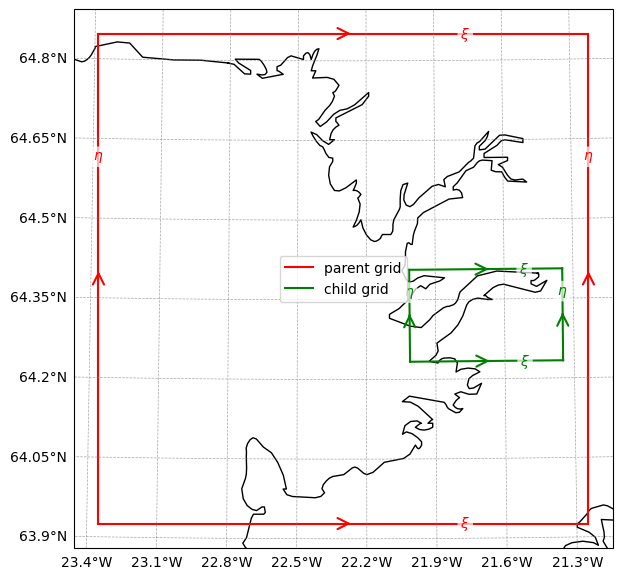
for v in child_grid.ds_nesting.variables:
    if "temp" in (child_grid.ds_nesting[v].output_vars):
        child_grid.ds_nesting[v].attrs["output_vars"] = child_grid.ds_nesting[v].attrs["output_vars"] + ", bgc"
Step 5: Child Grid Creation
Builds and writes the child grid file.
filepath = project+child_name+"_grid.nc"
child_grid.save(filepath=filepath)
2026-02-24 12:29:23 - INFO - Writing the following NetCDF files:
/anvil/projects/x-ees250129/x-uheede/INPUT_files/Iceland2_MARBL_2024/RT_EMOD/Iceland3_grid.nc
[PosixPath('/anvil/projects/x-ees250129/x-uheede/INPUT_files/Iceland2_MARBL_2024/RT_EMOD/Iceland3_grid.nc')]filepath_nesting = project+child_name+"_edata_UPDATED_2.nc"filepath_nesting'/anvil/projects/x-ees250129/x-uheede/INPUT_files/Iceland2_MARBL_2024/RT_EMOD/Iceland3_edata_UPDATED.nc'child_grid.save_nesting(filepath=filepath_nesting)2026-02-24 12:29:23 - INFO - Writing the following NetCDF files:
/anvil/projects/x-ees250129/x-uheede/INPUT_files/Iceland2_MARBL_2024/RT_EMOD/Iceland3_edata_UPDATED_2.nc
[PosixPath('/anvil/projects/x-ees250129/x-uheede/INPUT_files/Iceland2_MARBL_2024/RT_EMOD/Iceland3_edata_UPDATED_2.nc')]import xarray as xrfrom roms_tools import RiverForcing, Gridfrom datetime import datetimeriv0=xr.open_dataset('/anvil/projects/x-ees250129/Datasets/Iceland_river_dataset/Hvalfjordur_rivers_2023.nc')riv0['time']=[202401., 202402., 202403., 202404., 202405., 202406., 202407., 202408.,
202409., 202410., 202411., 202412.]Step 6: River Forcing Modification Output
Writes a modified river forcing NetCDF file.
riv0.to_netcdf('/anvil/projects/x-ees250129/Datasets/Iceland_river_dataset/Hvalfjordur_rivers_2024.nc')start_time = datetime(2024, 1, 1)
end_time = datetime(2024, 12, 31)river_forcing = RiverForcing(
grid=grid,
start_time=start_time,
end_time=end_time,
model_reference_date=datetime(2000, 1, 1), # this is the default
include_bgc=True,
source = {
"name": "DAI",
"path": "/anvil/projects/x-ees250129/Datasets/Iceland_river_dataset/Hvalfjordur_rivers_2024.nc",
"climatology": False
}
)river_forcing.dsriver_forcing.plot_locations()river_forcing.plot("river_volume")filepath = project+model_name+"_rivers.nc"Step 7: River Forcing Creation
Builds and writes the river forcing file.
river_forcing.save(filepath=filepath)Making some customizations to the river forcing (we have observed values of alk and DIC in the rivers and we also know the water is not going to be 17 degrees warm!). We add nutrients (observed values in fjord before spring bloom) and we add observed riverine values of Alk and DIC. These should be subject to change.
import xarray as xr
import pandas as pd
import numpy as np
import matplotlib.pyplot as plt
riv=xr.open_dataset(filepath)
riv.load()
# Create new array
new_tracer = np.zeros_like(riv['river_tracer'].values)
# Temperature varies sinusoidally with time
temp = 10 * np.sin(np.linspace(0, np.pi, riv.dims['river_time'])) # 12-month cycle
# Loop through tracers
for i, tracer in enumerate(riv['tracer_name'].values):
if tracer == 'temp':
new_tracer[:, i, :] = temp[:, np.newaxis] # vary with time
elif tracer == 'salt':
new_tracer[:, i, :] = 1
elif tracer == 'PO4':
new_tracer[:, i, :] = 0.4
elif tracer == 'NO3':
new_tracer[:, i, :] = 6
elif tracer == 'SiO3':
new_tracer[:, i, :] = 3
elif tracer == 'NH4':
new_tracer[:, i, :] = 0.4
elif tracer == 'Fe':
new_tracer[:, i, :] = 0.000197
elif tracer == 'Lig':
new_tracer[:, i, :] = 0.000465
elif tracer == 'O2':
new_tracer[:, i, :] = 360
elif tracer == 'DIC':
new_tracer[:, i, :] = 313
elif tracer == 'DIC_ALT_CO2':
new_tracer[:, i, :] = 313
elif tracer == 'ALK':
new_tracer[:, i, :] = 282
elif tracer == 'ALK_ALT_CO2':
new_tracer[:, i, :] = 282
else:
new_tracer[:, i, :] = 0.0
riv['river_tracer'] = (riv['river_tracer'].dims, new_tracer)plt.plot(temp)Step 8: River Forcing Modification Output
Writes a modified river forcing NetCDF file.
riv.to_netcdf(project+model_name+"_rivers_modified.nc")import xarray as xr
# Open your modified file
river = xr.open_dataset(project+model_name+"_rivers_modified.nc")
river.load()
# Show what tracers exist
river['river_tracer'].isel(ntracers=10).isel(nriver=6).plot()
Now, we make another river forcing file with half as much volume
riv['river_volume'][:] = riv['river_volume'].isel(river_time=7)*0.6winter_months = [1, 2, 3, 4, 11, 12]
# Create a boolean mask for winter times
winter_mask = riv['abs_time'].dt.month.isin(winter_months)
# Set river_volume to zero where the mask is True
riv['river_volume'] = riv['river_volume'].where(~winter_mask, 0.0)rivStep 9: River Forcing Modification Output
Writes a modified river forcing NetCDF file.
riv.to_netcdf(project+model_name+"_rivers_modified_new40off.nc")import xarray as xr
# Open your modified file
river1 = xr.open_dataset(project+model_name+"_rivers_modified_new40off.nc")
river1.load()
# Show what tracers exist
river1['river_volume'].isel(nriver=3).plot()
river1['river_volume'].isel(nriver=6)